Calculating Space
Template:Short description Template:Use list-defined references Template:Use dmy dates Template:Infobox book Template:Italic title

Calculating Space (Template:Langx) is Konrad Zuse's 1969 book on automata theory. He proposed that all processes in the universe are computational.[2] This view is known today as the simulation hypothesis, digital philosophy, digital physics or pancomputationalism.[3] Zuse proposed that the universe is being computed by some sort of cellular automaton or other discrete computing machinery,[2] challenging the long-held view that some physical laws are continuous by nature. He focused on cellular automata as a possible substrate of the computation and pointed out that the classical notions of entropy and its growth do not make sense in deterministically computed universes.
See also
References
Further reading
- Template:Cite book (70+4 pages)
- {{#invoke:citation/CS1|citation
|CitationClass=web }} (98 pages); Template:Cite book (69 pages)
External links
- Jürgen Schmidhuber's site Zuse's book and 1967 paper.
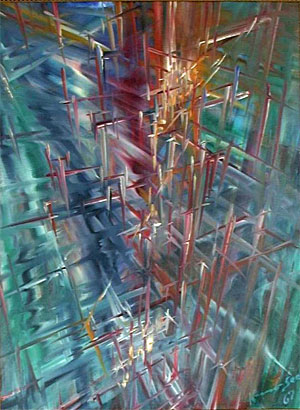
- Calculating Space - a painting by Zuse - Konrad Zuse's visualization of the idea
- Web article and simulation of such a calculating space in C and LIBPNG
- SecondSpace Simulation of waves within a 2D space (time and space are discrete), similar to FDTD. An OpenCL graphic card is needed.