There were a very considerable number of variants of "Christograms" or monograms of Christ in use during the medieval period, with the boundary between specific monograms and mere scribal abbreviations somewhat fluid.
The name Jesus, spelled Template:Lang in Greek capitals, has the abbreviations IHS (also written JHS, IHC, or ΙΗΣ). The name Christus, spelt Template:Lang, has XP (and inflectional variants such as IX, XPO, XPS, XPI, XPM). In Eastern Christian tradition, the monogram ΙϹΧϹ (with Overline indicating scribal abbreviation) is used for Template:Lang in both Greek and Cyrillic tradition.
And thus the whole mixture out of which he cut these portions was all exhausted by him. This entire compound divided lengthways into two parts, which he joined to one another at the centre like the letter X, and bent them into a circular form, connecting them with themselves and each other at the point opposite to their original meeting-point; and, comprehending them in a uniform revolution upon the same axis, he made the one the outer and the other the inner circle.{{#if:|
}}{{#invoke:Check for unknown parameters|check|unknown=Template:Main other|preview=Page using Template:Blockquote with unknown parameter "_VALUE_"|ignoreblank=y| 1 | 2 | 3 | 4 | 5 | author | by | char | character | cite | class | content | multiline | personquoted | publication | quote | quotesource | quotetext | sign | source | style | text | title | ts }}
<templatestyles src="Template:Blockquote/styles.css" />
The two great circles of the heavens, the equator and the ecliptic, which, by intersecting each other form a sort of recumbent chi and about which the whole dome of the starry heavens swings in a wondrous rhythm, became for the Christian eye a heavenly cross.{{#if:|
An alternative explanation of the intersecting celestial symbol has been advanced by George Latura, claiming that Plato's "visible god" in Template:Lang is the intersection of the Milky Way and the Zodiacal Light, a rare apparition important to pagan beliefs. He said that Christian bishops reframed this as a Christian symbol.[6]
The most commonly encountered Christogram in English-speaking countries in modern times is the Χ (or more accurately, Chi), representing the first letter of the word Christ, in such abbreviations as Xmas (for "Christmas") and Xian or Xtian (for "Christian").
Iota Chi (IX)
{{#invoke:Labelled list hatnote|labelledList|Main article|Main articles|Main page|Main pages}}
An early form of the monogram of Christ, found in early Christian ossuaries in Palestine, was formed by superimposing the first (capital) letters of the Greek words for Jesus and Christ, i.e. iotaΙ and chiΧ, so that this monogram means "Jesus Christ".[7]Template:Rp
Chi Rho (ΧΡ)
{{#invoke:Labelled list hatnote|labelledList|Main article|Main articles|Main page|Main pages}}
St Cuthbert's coffin (late 7th century) has an exceptional realisation of the Christogram written in Anglo-Saxon runes, as ᛁᚻᛋ ᛉᛈᛋ, transliterated to the Latin alphabet as 'IHS XPS', with the chi rendered as the eolh rune (the old z or algiz rune) and the rho rendered as the p-rune.
In the Latin-speaking Christianity of medieval Western Europe (and so among Catholics and many Protestants today), the most common Christogram became "IHS" or "IHC", denoting the first three letters of the Greek name of Jesus, Template:Lang, iota-eta-sigma, or Template:Lang.[10][11][12]
The Greek letter iota is represented by 'I', and the eta by 'H', while the Greek letter sigma is either in its lunate form, represented by 'C', or its final form, represented by 'S'. Because the Latin-alphabet letters I and J were not systematically distinguished until the 17th century, "JHS" and "JHC" are equivalent to "IHS" and "IHC".
Used in Latin since the seventh century, the first use of IHS in an English document dates from the fourteenth century, in Piers Plowman.[15] In the 15th century, Saint Bernardino of Siena popularized the use of the three letters on the background of a blazing sun to displace both popular pagan symbols and seals of political factions like the Guelphs and Ghibellines in public spaces (see Feast of the Holy Name of Jesus).
The IHS monogram with the H surmounted by a cross above three nails and surrounded by a Sun is the emblem of the Jesuits, according to tradition introduced by Ignatius of Loyola in 1541.[13]
IHS has been known to appear on gravestones, especially among Irish Catholics.[16][17][18]
On icons, this Christogram may be split: 'ΙϹ' on the left of the image and 'ΧϹ' on the right. It is sometimes rendered as 'ΙϹ ΧϹ ΝΙΚΑ' (Template:Lang), meaning 'Jesus Christ Conquers'. 'ΙϹΧϹ' may also be seen inscribed on the Ichthys.
After Francis Xavier landed in Kagoshima, Japan, in 1549, his missionary work grew and became widely distributed throughout Japan under the patronage of the Template:Transliteration. However, during the Edo period (1603–1867), Christians were persecuted and forced to hide. Because they were forbidden to openly reverence the images of Christ or Mary, it is believed that they transferred their worship to other carved images and marked them with secret symbols understood only by the initiates. Certain Japanese lanterns, notably the Template:Transliteration (Template:Lang, 'Christian lanterns'), did bear the "Lhq" monogram, which, a quarter turned, was engraved on the shaft (Template:Transliteration), which was buried directly into the soil without basal platform (Template:Lang). The 'Lhq' monogram corresponds to the distorted letters 'IHS'.[21]
Archaeology
In 2016, a 1,300-year-old corpse, was found in a cemetery near a medieval monastery in Ghazali, Sudan, whose right foot bore a tattoo from medieval Nubia, a region that covered parts of modern-day Egypt and Sudan, depicting a Chi Rho and an Alpha Omega. The person, most likely male, lived sometime between 667 and 774.[22]
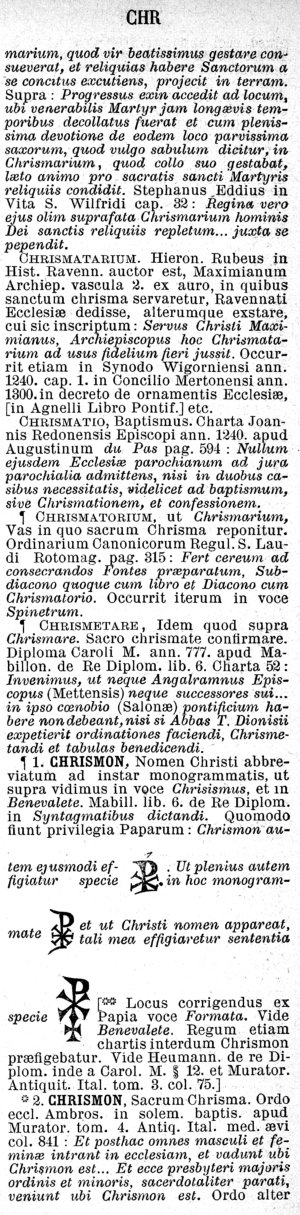
↑Chrisimus (par les Bénédictins de St. Maur, 1733–1736), in: du Cange, et al., Glossarium mediae et infimae latinitatis, ed. augm., Niort : L. Favre, 1883‑1887, t. 2, col. 317b. "CHRISIMUS, Nomen Christi abbreviatum in antiquis instrumentis secundum diversos casus sic XPS. XPI. XPO. XPM. ubi media littera P. Græcum. Vox Chrisimus legitur in Annal. Benedict. tom. 5. pag. 7."
↑Crismon (par les Bénédictins de St. Maur, 1733–1736), in: du Cange, et al., Glossarium mediae et infimae latinitatis, ed. augm., Niort : L. Favre, 1883‑1887, t. 2, col. 621b.
"CRISMON, Nota quæ in libro ex voluntate uniuscujusque ad aliquid notandum ponitur. Papias in MS. Bituric. Crismon vel Chrismon proprie est Monogramma Christi sic expressum ☧"
1 chrismon (par les Bénédictins de St. Maur, 1733–1736), in: du Cange, et al., Glossarium mediae et infimae latinitatis, ed. augm., Niort : L. Favre, 1883‑1887, t. 2, col. 318c, citing Heumann. de re Diplom. inde a Carol. M. § 12; Murator. Antiquit. Ital. tom. 3. col. 75.